SEO and Web Design: How to Create Websites that Rank in 2025
Author :
- The Blog Offers…
- What is SEO and Web Design?
- Role of Designers and SEO Specialist
- Why SEO & Web Design Matter?
- Some SEO Related Facts
- The Major SEO-Friendly Web Design Principles
- Technical SEO Essentials
- Best Keywords for Website Development Company
- Use of Artificial Intelligence in SEO Web Design
- Predicting Trends and Competitive Insights
- Common SEO Friendly Website Design Errors
- Case Studies: Is Shopify Good for SEO?
- How to Redesign Your Web With SEO
- SEO and Web Design Tools
- How to Measure Success of SEO and Web Design
- SEO And Web Design Trends in the Future
- Conclusion
- Want Your Website to Rank?
In today’s age, both, you and I are experiencing good SEO website example every day. It means that the SEO and web development game has reached another level. It is no more about just a basic web designing and SEO in play.
You need proper website development and designing. Once done, the game is not over because then optimization gets into the frame.
Optimized web design help you rank, and when you rank well, you get more visitors which leads to more leads. Hence, fulfilling the SEO and web design goal.
The best SEO web designs are the results of early-stage optimization. When you juggle between web development and SEO, you end up with websites that are meant to have more exposure.
SEO is the key to organic searches which is the goal of every SEO friendly web design company because it gets more than half of all web traffic.
The Blog Offers…
The blog is an easy guide that help SEO for designers to deliver a high-ranking site. For professional SEO web developers, the goal is to provide a positive user experience which comes from a few major things such as mobile-friendly design, optimized content and media, technical SEO and AI tools.
What is SEO and Web Design?
Having the two together, SEO and web design, will get you a site that is good looking as well as easy to navigate. Now, what we don’t understand when to comes to best website design for SEO is that we overlook the SEO and focus on design only.
An attractive site is going to be appealing but what’s the point if it does not get indexed? This is why; Google threw a major shift towards having the importance of having optimized sites.
Absence of a proper webdesign and SEO will resist search engines to read and index your site, hence, losing traffic. When we talking about SEO website designs, we refer to the optimized structure, optimized responsivity, appearance and inclusivity of site.
Role of Designers and SEO Specialist
To do the SEO for a new website, you need an SEO expert who understands the role of headings, meta tags, internal links, and keywords in Google ranking.
If you can invest more, hire both to the SEO specialist and the web developer to do the SEO and website development. As a web design plus SEO company, you can get clients that want their website to have SEO and website redesign. Redesigning or optimization alone can make huge changes, if you’re doing it right.
The balance of SEO and web design is important to generate impactful sites. In 2025, those who focus on creating websites with SEO provide great user experience, get easily discovered, get traffic and retain past customers.
Why SEO & Web Design Matter?
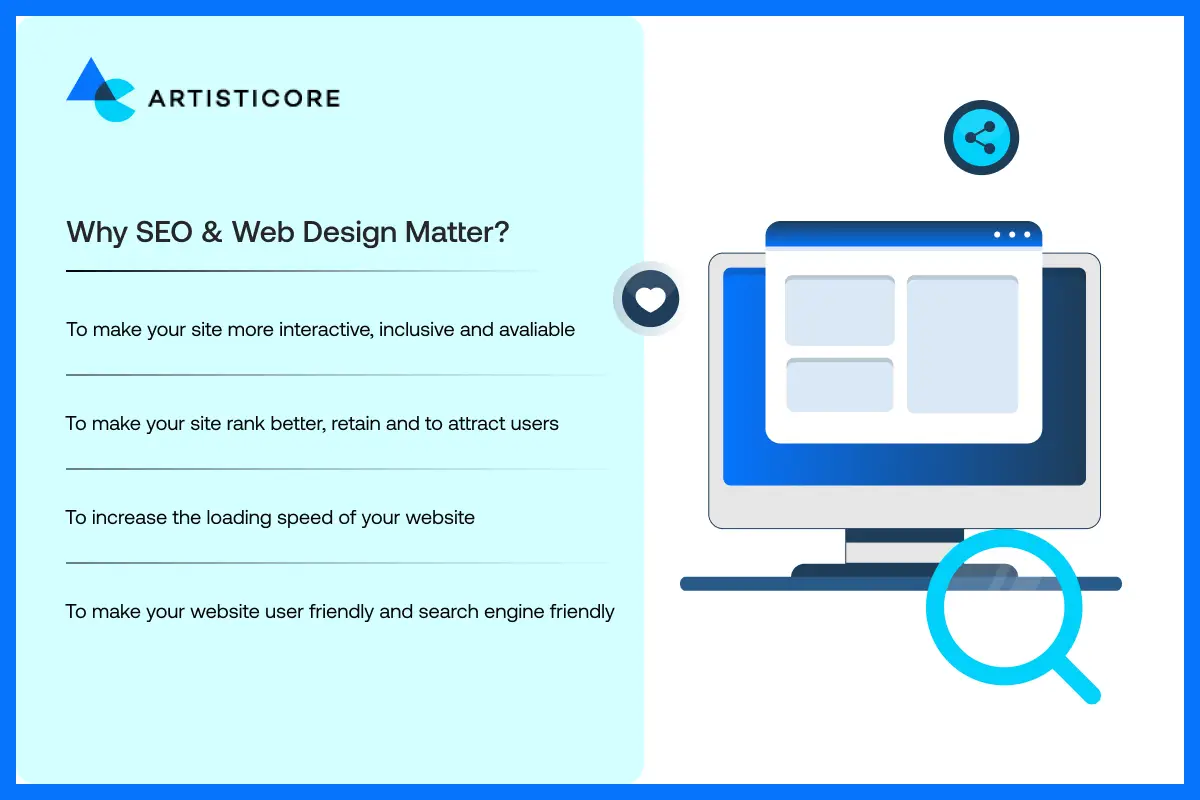
During the design and development, we need to focus on website usability and how well and quick the website appears on Google. Now, we focus on both, user friendly and search engine friendly website design.
The combination of SEO and web design not only help you rank but increase the loading speed of website. Web design for SEO is there to make your site more interactive, inclusive and available. With poor web development SEO, you will experience slow page loading speed, or confusing navigation which will lead to lose of traffic. A high-ranking site is the one you want, to retain and to attract.
Some SEO Related Facts
As we know by that now that Google ranks pages based on user interaction, how much the site is accessible to all and how users behave when using it.
According to Backlinko, the Google top result has 27.6 percent of the clicks and only 0.63 percent of users that pass the first page. This shows how making even one page website SEO friendly can help you get interaction.
It is mentioned in the blog by Digital Silk that 63.31% of the web traffic is through mobile browsing which regards mobile responsive SEO and website design.
According to the stats mentioned by WebFx, video content can increase the organic rankings 53x relative to the text alone.
The Major SEO-Friendly Web Design Principles
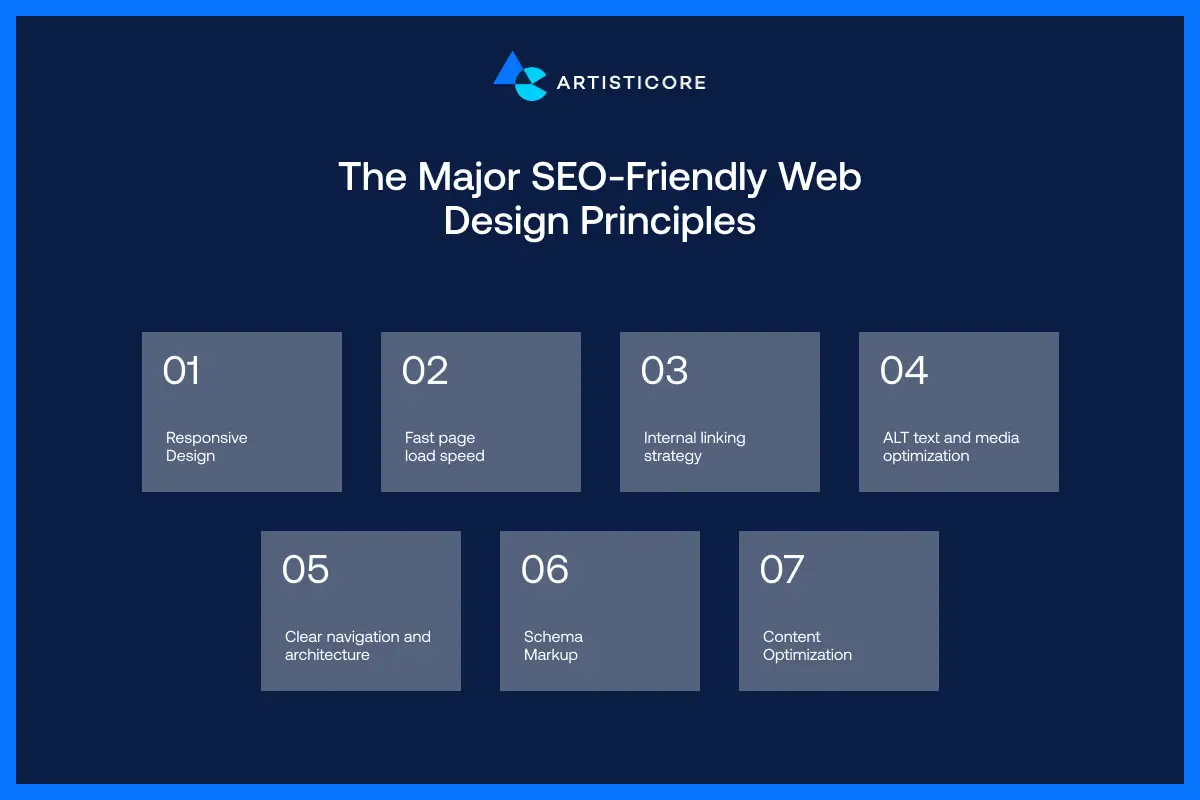
Responsive Design
Design for mobile first. A responsive site is compatible with all devices and is easily navigated and readable. Mobile optimization leads to a better user experience and ranking. Make sure that you use touch-friendly buttons, readable fonts, and images that are mobile friendly.
Fast Page Load Speed
Sluggish websites are irritating and bad at search engine optimization. Minimize images, file compression and minimize scripts. Certain tools such as Google PageSpeed Insights are used to balance the images and speed. Quick pages reduce the bounces and increase the conversions.
Clear Navigation and Architecture
The clear structure and a simple menu are helpful to users and search engines. Breadcrumbs should be used, the URLs must be descriptive, and the hierarchy must be maintained so that a user can access what he or she wants with at most four clicks. Architecture makes the crawling easier and increases UX.
Content Optimization
Create quality content with key words in terms of headings, lists and multimedia. Add LSI words regarding web design and SEO to enhance appearance. The content must respond to user queries and provide actual value.
Alt Text and Media Optimization
Add text description to images and videos. Thumbnails of video in Google searches are displayed in 26%. Optimization of media enhances search access, interactive, and search engine optimization.
Schema Markup
Formatted information assists search engines to know what a page entails. Add schema to articles, products, frequently asked questions, and local business information to maximize the probability of rich snippets.
Internal Linking Strategy
Take advantage of effective internal linking in order to enhance crawling and maintain traffic. Related content allows visitors to stay in the site and improves search engine optimization.
Want your site to rank and convert? Allow Artisticore to build an SEO-friendly site that will generate actual traffic and outcomes
Technical SEO Essentials
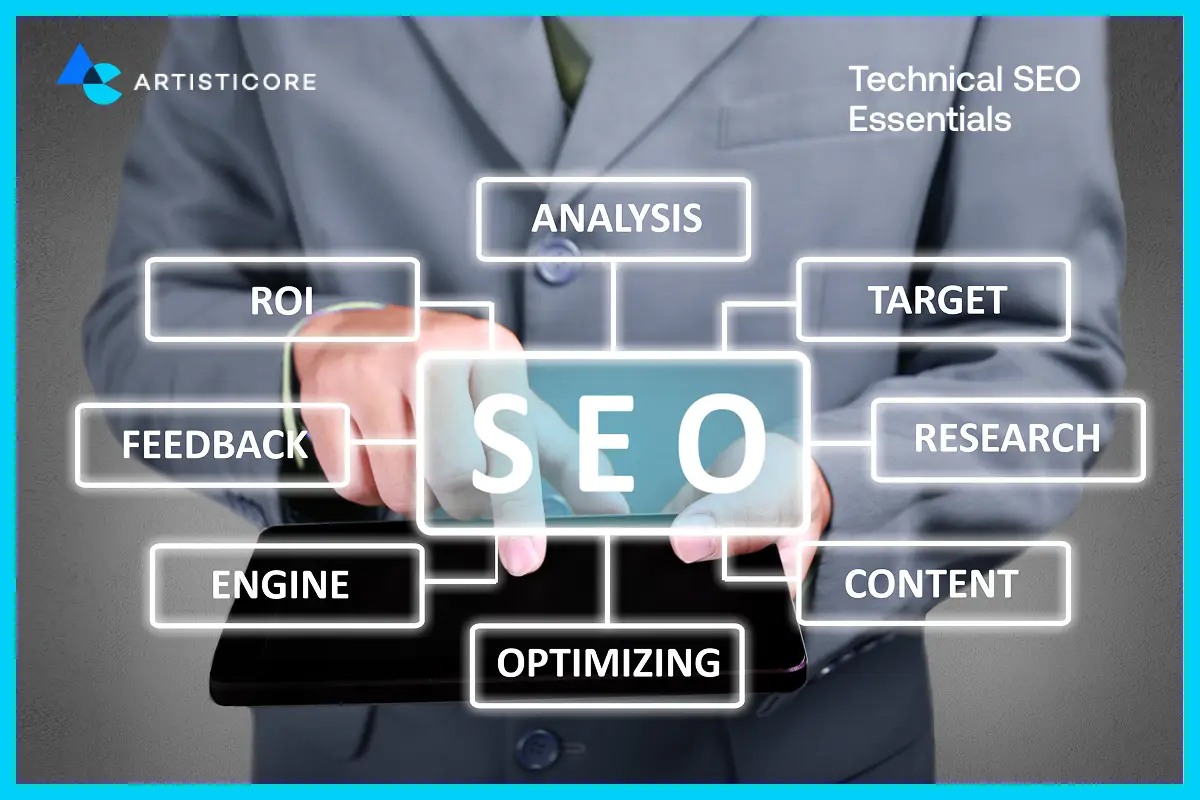
Technical SEO ensures that your site is searchable and ranked by the search engines. Pay attention to simple crawling of the web site using XML sitemaps, clean URLs and good redirects.
Ensure that your page titles and descriptions are understandable since they influence the click through rates. If it is about speed, compress those images and use effective code.
Repair broken links and make sites mobile friendly. Use HTTPS to keep it secure, and do not forget to use canonical tags to prevent duplications.
To audit, there are tools such as Screaming Frog or Ahrefs that will help identify issues.
A robust site provides you with a solid foundation in terms of SEO therefore a pleasing user experience to have your content reaching the right audiences.
User Experience and SEO Design
The experience users will have when they navigate through the page is important because this will help you rank.
You can either make fonts readable or add color contrast. Then, you can also use content that is easy to read and understand. All these things make users stick to your web page and convert.
Having a defined visual hierarchy demonstrates what is important and leads the users through the content.
Interactive features such as calculators, sliders, or quizzes are capable of keeping people interested when they load fast.
Good UX informs search engines that the page is worth attention, increasing the ranking and retaining visitors in the site.
The combination of UX design and SEO makes each page a top search and leads to turning visitors into leads or customers.
Conversion Rate Optimization (CRO)
CRO transforms visitors into customers, leads or subscribers. It is a combination of design, UX and SEO.
Concise points of action, minimal forms, visual importance, authority cues, and convincing messages assist individuals to act.
It is good to test various versions of pages, headings, and buttons to find out which works better.
CRO also examines source of traffic, user behavior and what keeps them on pages so that the pages can continue to improve.
The proper combination of SEO, UX, and design attract the right visitors and encourage them to take action.
Quick loading, user-friendliness, and suitable navigation minimize friction. Connecting SEO, design, and CRO businesses achieve greater returns on their traffic.
Each of the tweaks, such as the arrangement of the buttons or the readability of the content, facilitates the journey between the discovery and the conversion.
Content Marketing and SEO-Friendly Web Design
SEO and content marketing collaborate with design. Good sites provide answers on six questions: Why does the content exist? Who should see it? What is the main message? Where will users find it? How will it be shown? When must it be posted?
Designers work with SEO experts to make layouts that are readable. They also work on optimizing images because the media adds an appeal. Then, the organization and the structure of content is also important because it helps users locate the information.
E‑A‑T and Content Authority
E- A -T is Expertise, Authoritativeness and Trustworthiness, a Google quality benchmark of content.
High E-A-T signals contribute to better ranking of pages, particularly in case of YMYL. Sites may enhance E-A-T through displaying credentials, author bios, testimonials and actual references.
Credibility is created through accurate, well researched original content. Trust is also added by the backlinks of reputable sites.
The E-A-T with SEO and design will help the users to trust your site and search engines will recognize the value of your site.
Use of clear fonts, uniform branding and professional layouts favors credibility. Using E-A-T into your materials improves your website DR and allow users to interact, create trust, generate loyalty and positive image.
Optimization of All Devices
Mobile is essential. Phones constitute over 63 percent of the traffic hence the design needs to be responsive and quick.
Make your images and videos mobile-friendly, touch-friendly buttons and forms, and begin with a mobile-first design.
Test on different devices to remove issues like pinch-to-zoom or lengthy scrolling.
A good mobile SEO can boost the ranking, enhance the experience, and retain the people in conversion.
Multimedia and Video SEO
Multimedia maintains the interest of people and assists in SEO. Videos will take 82 percent of the internet traffic and will be seen in 26 percent of Google search results.
Label video files appropriately, include alt text and transcripts and that makes them more visible.
With interactive features like sliders, infographics and animations, you can increase the engagement of your site.
Do not allow media to slow down the page, compress files and load slowly. Rich media retains people on the site, indicates value to search engine and enhances ranking and satisfaction.
Grab Local Traffic
Local SEO matters more now. About 42% of users do clicks on Google Maps Pack outcomes. Maximize Google Business Profiles, ensure the location pages are mobile-friendly, and apply local schema markup.
Include contact details, speedy pages, and local keywords, reviews and maps to feature in local search results.
A locally optimized site will gather traffic, increase leads, and allow your business to experience organic traffic to make sales.
Security and SEO
Security has an impact on SEO and trust. Secure websites operate in the HTTPS which encrypts the information between the server and the browser. Google promotes ranking to HTTPS websites.
Security prevents data breach, malware, and phishing as well, securing the business and users. Install secure sock layer certificates, update CMS, and plugins and themes, and look after vulnerabilities.
Two-factor authentication, firewalls, and strong passwords are also beneficial towards security. Customers enjoy safe web pages and they will tend to make purchases, whereas search engines will promote security.
This is because integrating security and technical SEO ensures your site is crawlable, well indexed and valid. Security is not an IT problem only in 2025, but it is a fundamental aspect of SEO strategy and user experience.
Best Keywords for Website Development Company
It is very important to choose the best SEO keywords for web design company which are either related to web design keywords or web designer keywords. Keywords are two or three words that helps you get discovered on the internet because audience look for you using those.
They help you get organic traffic and boost sales. Getting great and direct outcome is very much possible just by using the correct website design keywords if you’re running a web design agency.
Mention Your Services in Keywords
You can start with keywords that talk about your product and services i.e. website development and SEO, professional web development, web design and development company, and custom website developers.
Add Location & Affordability
These keywords attract individuals with what they are seeking. You can also add location for example use a keyword that says best keywords for web design company in Houston.
Add any city or country you like that can help you get more searches. One more thing is mentioning the affordability, for example, cheap or affordable SEO site design.
Use of Long Tail keywords
They are big chunks of words such as ecommerce SEO friendly website development or how to do your own search engine optimization that helps you get more leads or increase your hiring chances.
Other Factors
There are number of things to look at before you decide to use a keyword such as how much your content is relevant to the overall subject matter. The number of people searching, the difficulty of the word, what is the nature of desire, and keyword variety.
Keyword Research Tools
To choose the best keywords for website design or anything in general, there are keyword search tools available. The most popular are either Google Keyword Planner, SEMrush or Ahrefs. Whenever you are searching for a keyword, go with the combination of primary, secondary, and long tail keywords. This will help you appear in numerous searches and attract high value clients.
Use of Artificial Intelligence in SEO Web Design
SEO and web design are rapidly transforming with the use of AI. Over 70 percent of the population consult AI tools to locate information and approximately 30 percent of search queries refer to Google AI. The search engines have now shown preference to sites that are well organized and easy to read by AI.
ChatGPT, Jasper, SurferSEO, and Clearscope allow one to create good, optimized content. They propose keywords, create meta-description and suggests alterations depending on the most appropriate pages. These are good tools for SEO when building a website because they help save time and keep the content relevant to the user searches.
AI can analyze the user behavior and recommend improved page layout, navigation and design. It also suggests how to accelerate pages including compressing media and optimization of scripts resulting in quicker load times and increased interaction.
Predicting Trends and Competitive Insights
Artificial intelligence monitors the competitors, identifies emerging keywords, and anticipates changes in search. The best SEO website designers will definitely use AI to do the optimization which will help them keep up with the new trends and generate more friendly sites.
Common SEO Friendly Website Design Errors
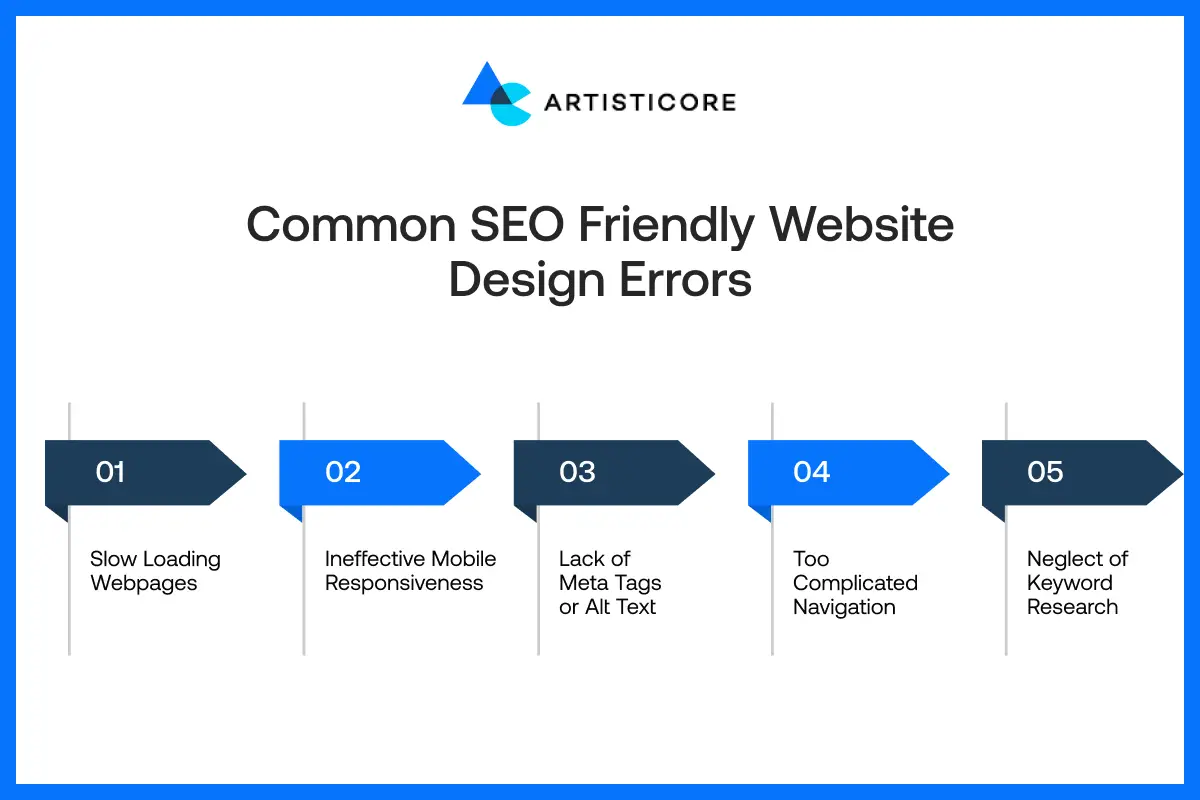
Slow Loading Webpages
It makes people walk out and harms SEO. To enhance speed, you can compress image, and optimize scripts.
Ineffective Mobile Responsiveness
Sites which fail to respond to phones are a frustration to users and lose rankings. Mobile-first design is important in terms of SEO and user experience.
Lack of Meta Tags or Alt Text
When pages do not have meta tags or alt text the search engines are not likely to index the content well. Always include titles, description and alt text of images.
Too Complicated Navigation
Menus should not be confusing to users, as well as to search indexers. Make navigation easy and easy to understand.
Neglect of Keyword Research
A site can be ineffective without using the right key phrases to reach the right people. Identify what people really search and match content.
Problem with design and SEO? Artisticore builds search-ready, fast, and clean websites that suit your brand.
Case Studies: Is Shopify Good for SEO?
Good websites combine design, content and search engine optimization. Product pages in Shopify stores are fast to load, include clear description, and drive aggressive calls to action. To climb up the ranking, blogs publish long posts of more than 1,800 words using intelligent keywords. Photos, videos, and interactive components make the sites fast. Basic navigation and connection aid the users and search engines to locate content fast. These are just to show that design, content, and optimization are joint efforts that generate visits and sales.
How to Redesign Your Web With SEO
Audit Current Content Before Redesign
Manage traffic, page ranking and technical problems before redesign. Find broken links, duplicate pages and good URLs. Note down the redirects to remain at the same ranking position. Auditing helps the new site retain or enhance existing rankings and customer experience.
Use Responsive Designs
It is important to make site responsive to increase engagement. You can do this by enhancing images, add touch buttons and adaptive layout for mobile users. Mobile-first design enhances the UX, reduces the bouncing rates, and improves the rankings. All these things help retain users across all platforms.
Use Descriptive URLs
Descriptive URLs are engine friendly as well as user friendly. You can include trendy words in the URLs such as /seo-tips-web-design as opposed to /page?id=123 to stand out. With proper URL structure and 301 redirects, you can rank high and deliver content that is easy to navigate content.
Speed up Pages and Multimedia
Compress graphics, lazy-load videos and optimize code. Quick pages are better in interaction and search optimization. Multimedia is not supposed to drag down the site, but rather help to improve the experience.
Add Structured Data and schema Markup
Add articles, product, FAQ, and local business schema. With proper formation, there is high possibility of rich snippets, better indexing, and higher click rates.
SEO and Web Design Tools
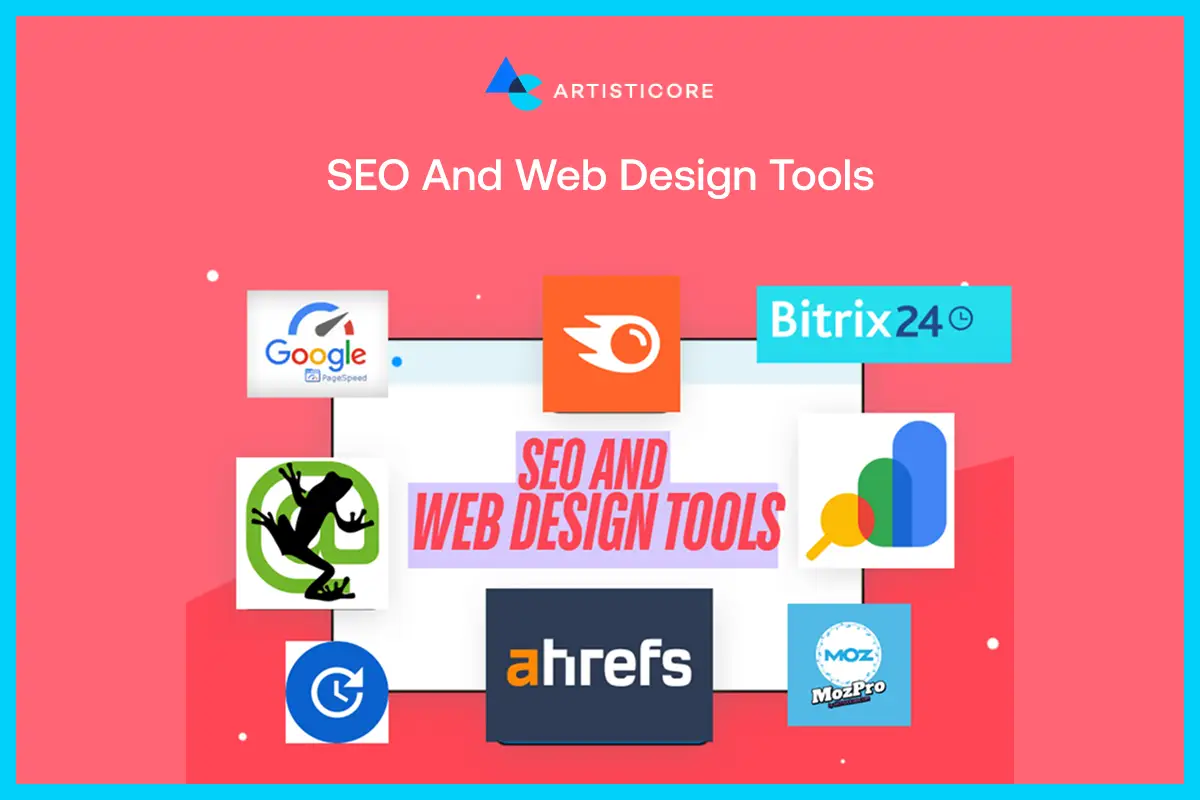
There are number of tools that SEO experts and designers can use to better the functionality of web design. In SEO and web design, the use of tools plays a crucial role. These help make both the design and SEO far more effective and data-driven, increasing the rankings and interest.
For example, tool such as Google search console helps with rankings and indexing.
There is another tool called PageSpeed Insights which helps you evaluate the page loading speed.
The tool keyword search tool are Ahrefs and SEMrush which help you locate the trending keywords.
Screaming Frog is another tool that identifies all the technical issues.
Then, to check website performance and to optimize and monitor, tools like GTmetrix and Moz are available.
How to Measure Success of SEO and Web Design
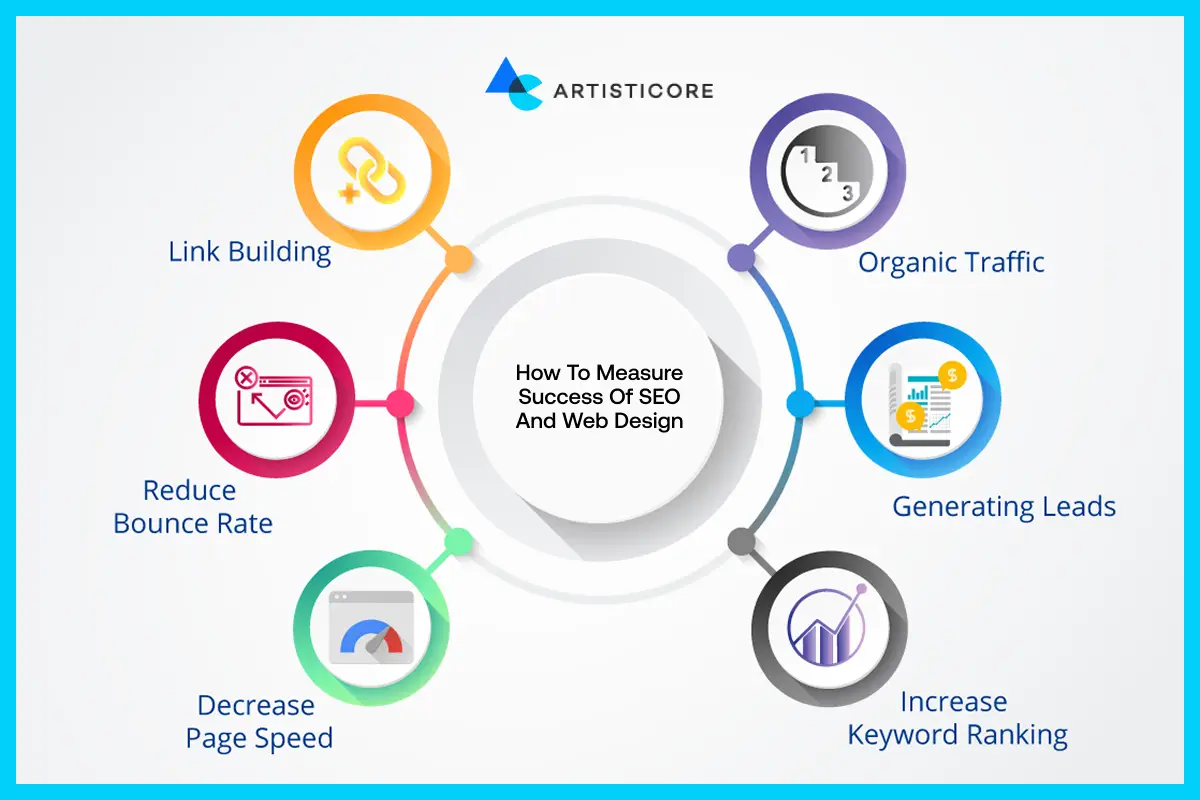
Do these three things, first track, then analyze and finally improve. Watch bounce rate, dwell time, search result clicks, keyword positioning and organic traffic.
You can easily track the impact of SEO by looking at the number of signups and user purchase.
When your identity any weak points, you can start improving. The goal is to keep on continuing content and design using analytics.
Consistent monitoring provides minor improvements, which enhance the visibility, involvement, and ROI.
Measuring success will mean that the site is able to capture the interest of the visitors but convert them into customers.
SEO And Web Design Trends in the Future
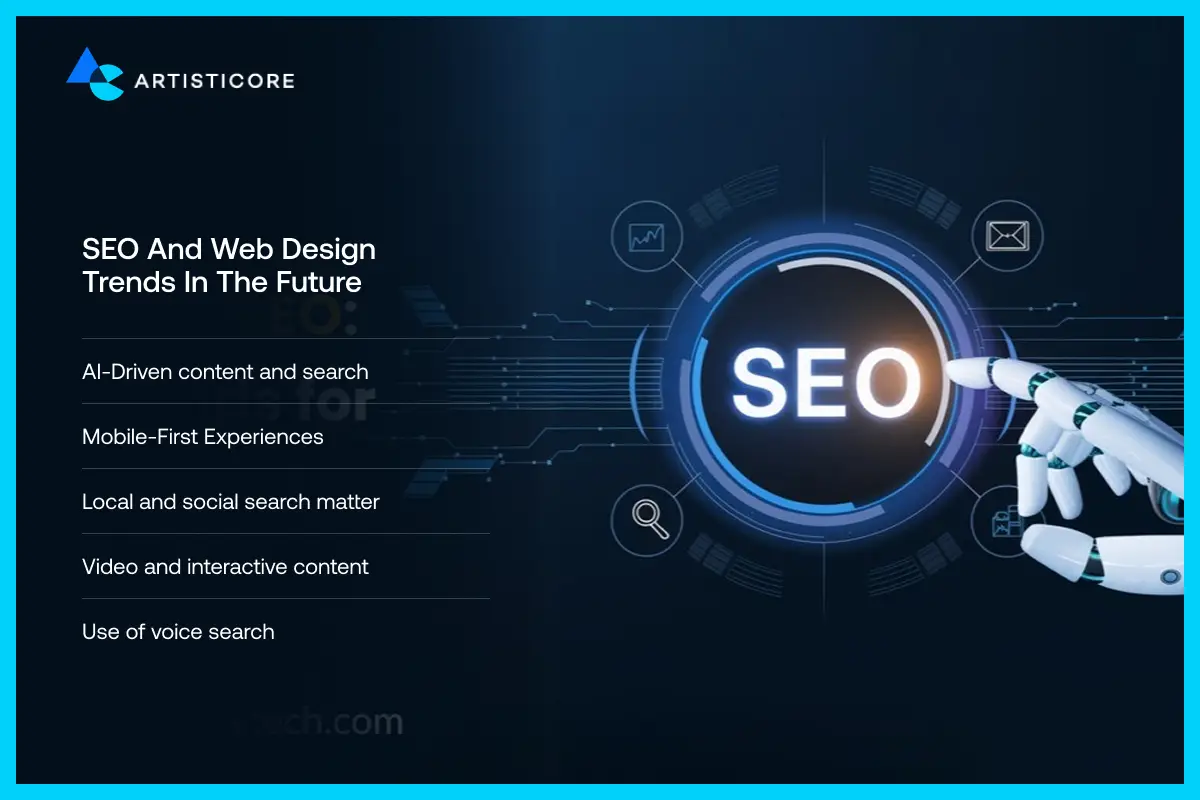
AI-Driven Content and Search
AI technologies are used to identify keywords, user behaviour, and proposals regarding content modifications. AI-based SEO increases ranking opportunities and accelerates web design.
Use of Voice Search
Naturalize and make content converse. The voice-friendly posts will be more visible in the voice search results.
Video and Interactive Content
Interactive media retains users longer on the page. The use of videos, quizzes, and animations demonstrate usefulness to search engines and increase ranks.
Mobile-First Experiences
Mobile first design focuses on responsiveness and speed. Search engines will prefer websites that are mobile friendly, that is, they will rank them highly.
Local and Social Search Matter
Local search and social relationships allow a site to appear close to the users who are relevant. Maximization of local search and social media provides focused traffic and buyers.
Conclusion
There must be a connection between SEO and design. Web sites are to be fast, phone friendly, attractive, and technically robust. Watch out to the quality content, clear information, videos and pictures, and user-friendly interface so that people can locate the site and be ranked high. Monitor numbers, apply AI technology, and remain abreast of emerging technologies such as voice search and interactive pages. Design and SEO produce the most traffic, interest, and sales when begun simultaneously.
Want Your Website to Rank?
Collaborate with Artisticore to have a gorgeous, search-engine-friendly site that expand your business.
FAQs
Yes. SEO simplifies locating a site as well as its utilization. It is without a pretty site not likely to receive visitors.
To have SEO friendly websites, go with layout that works on all devices. Keep URLs short and clear. Make pages load quickly. Use simple tags. Write good content. Make links with other pages on your site.
Yes. Test the pages that already exist, keep the same URLs, redirects and optimize the new content so that the ranks do not drop.
AI assists with finding useful keywords, observing the behavior of people, recommending more efficient content, and providing design advice to ensure that the site can be ranked higher and remain useful.
The speed of loading of the page, its functionality with phones, the simplicity of the menu, the structure of the content, the connection between pages with each other, and the description of images change the quality of the site in search and user experience.

Hafsa Hanif is a talented content writer at WebnHubs, specializing in topics such as graphic design, web design and development, logo design, and animation. With her deep understanding of design principles and creative processes, Hafsa crafts engaging, informative, and SEO-optimized content that resonates with readers. Her expertise in SEO ensures that her articles not only captivate audiences but also rank well on search engines, helping businesses boost their online presence through compelling design-focused narratives.
