What Is Back End Development? A Quick Guide
Author :
- The Guide Offers…
- What Does Backend Mean?
- What is a Backend vs Frontend Development?
- Key Back-End Developer Skills
- Backend Technologies and Tools
- Career Path and Growth Opportunity
- How to Learn Back-End Development: Step-by-step Guide
- Typical Back End Development Problems and How to Address Them?
- Conclusion
- Start Your Back-end Project Today!
I know you all have been wondering why some websites load faster than the other? This is exactly where what is back end development comes into play.
Backend app development is similar to the back stage crew in a show. The front end is is what you see and also the part that you work with. However, the back end ensures that everything in the background functions. In its absence, the show does not take off.
Back end infrastructure is the unseen part of a webpage or application. It involves servers, databases and the logic that make it all run. You see the magic of the backend server when you log in, check your account, or make a purchase.
The Guide Offers…
In this guide, we will discuss what is back end development in simple terms. At the end, you will understand what does a back end developer do, the back end languages, tools and technologies, the required skills, career opportunity, and the overall backend developer roadmap.
Whether you are interested in learning back end coding, or back end development services, this guide is you go to call.
What Does Backend Mean?
Back end is like a busy kitchen. You can never see it when you are eating, but all the chopping and cooking is done there. The kitchen in the web world is comprised of servers, databases and code which render the front end beautiful in your screen.
Server‑Side Programming
The servers are cooks in the kitchen. They receive all your requests such as logging in or adding a product to your cart, form the data, and treat you with a well-formatted response. Server-side code is written in Python, Java express, PHP, Ruby and Node.js. Such programs instruct the server on the way to process requests and provide the appropriate response.
Databases
Databases are like pantries. They contain all the information such user accounts, product descriptions, transactions and content. There are two main types:
- One is SQL Databases (MySQL, PostgreSQL): They are organized, labeled, shelf-like databases.
- Another is NoSQL Databases (MongoDB, Firebase): They are unstructured, flexible, similar to open bins.
These databases are run by back end web developers who carry out CRUD operations. CRUD stands for Create, Read, Update, and Delete. In backend systems, they ensure the pantry or they system is stocked to allow the chef (the server) to work efficiently.
Application Programming Interface (APIs)
In backend architecture, APIs act like waiters. They interpret the orders given by the front end (the customer) and retrieve the results.
Servers commonly communicate with apps and websites in RESTful APIs and GraphQL. You want to use Google to log in or live stock prices? The API can handle that.
Security and Authentication
If there is any backend engineering issue, back end solutions are always available. To solve any security issue, programmers install authentication to check who you are.
This is followed by encryption which means protecting the data and then using anti-attack-computer-programs such as SQL injection.
If back end was a kitchen, then it will ensure that the kitchen is clean as well as guard all the secret recipes.
Performance Optimization
Consider a kitchen that will take 30 minutes to deliver a burger. That’s unhelpful. The back-end web application developers make things faster by caching, balance loading speed and assort to ensure that the apps remain fast to many users.
Fun Fact: According to Forbes, over 53% of the users do not wait longer than 3 seconds for a page to load. This is why it is important to optimize the website backend.
What is a Backend vs Frontend Development?
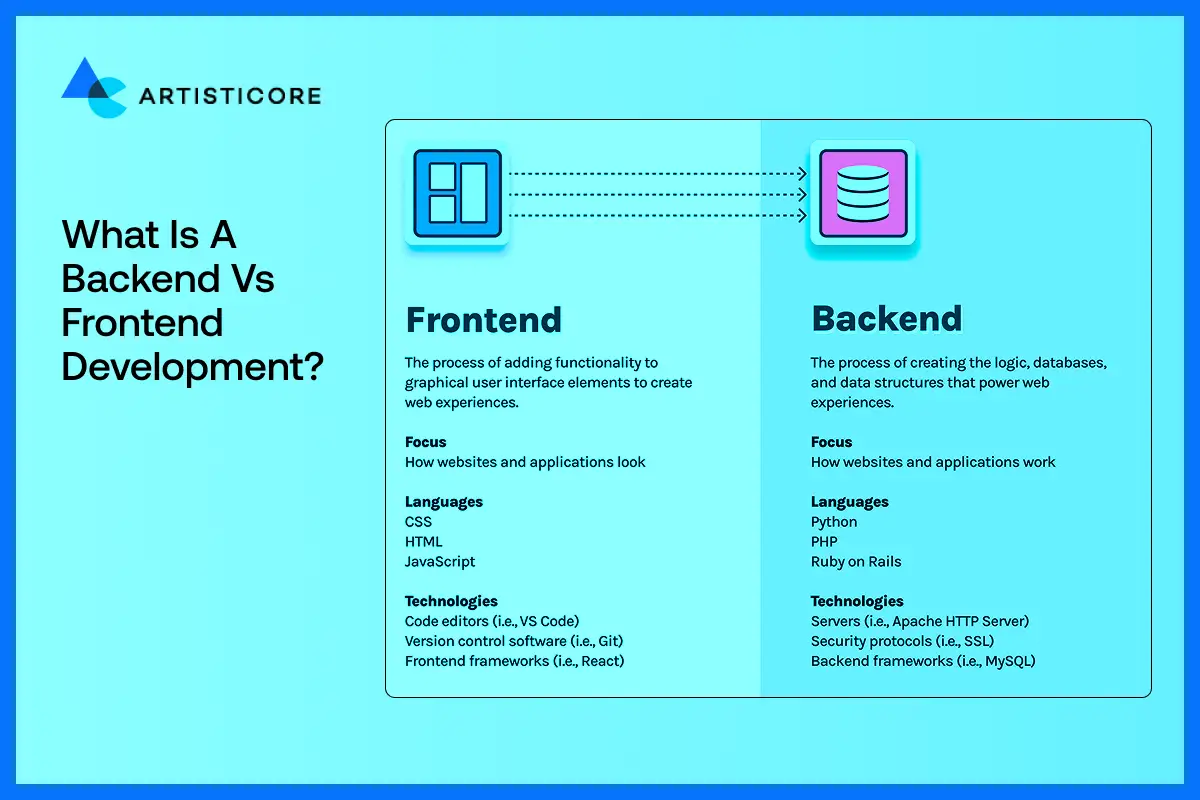
Upon visiting a site, all the contents are divided into two major components: the front end and the back end. What is front end now? It is whatever is visible on the screen, the colors, buttons, pictures, text and the motion of everything as you hit the button.
Whereas, backend definition refers to the component that operates behind the scenes. It ensures that the site is functional. To understand backend meaning, just imagine it is like a show. In a show, the front end is the actors on stage, and what is backend? It is the crew who work on the lights and sound.
Front End (Client‑Side)
The front end is the face of the internet that you see. Once you open a site, there is a clean layout, images that load without any issues, and buttons that respond to the hovering done by the end-user, all front-end-done work.
HTML is used by front-end developers to structure the page, CSS to make it look good and Java backend developer that make it interactive.
Their aim is to keep the experience pleasant, fast and easy to users. The front end is all about the feel and presence, it gives site a good appearance.
Back End (Server‑Side)
The hidden engine is known as the back end of a site. It is not visible to users; however, in its absence the site is inoperable.
It stores, processes, secures and transmits information. The backend languages such as python backend framework, PHP, Java, or Node.js and databases such as MySQL or MongoDB are used by back-end developers.
They additionally deal with servers, APIs, login, and security. Imagine the back end as the engine room It is not seen, but it is something essential.
The Collaboration Between the Front End and Back End
Although these two are different, the front and back-end communicate with each other constantly. In case, when you log onto a site, you enter your username and password on the front side. That information is sent to the back end which compares it with the database. When it is a match, the back end responds that everything is right and the front end displays Welcome!
The same thing occurs upon seeing a product. The front end clicks on the product card and the back end retrieves the information in the database. Once done, the front end shows the price, description and images.
In simple terms, the front end ensures that a website looks beautiful, and the back end ensures that the website functions. The two are mutually dependent and they combine to form the entire user experience.
Key Back-End Developer Skills
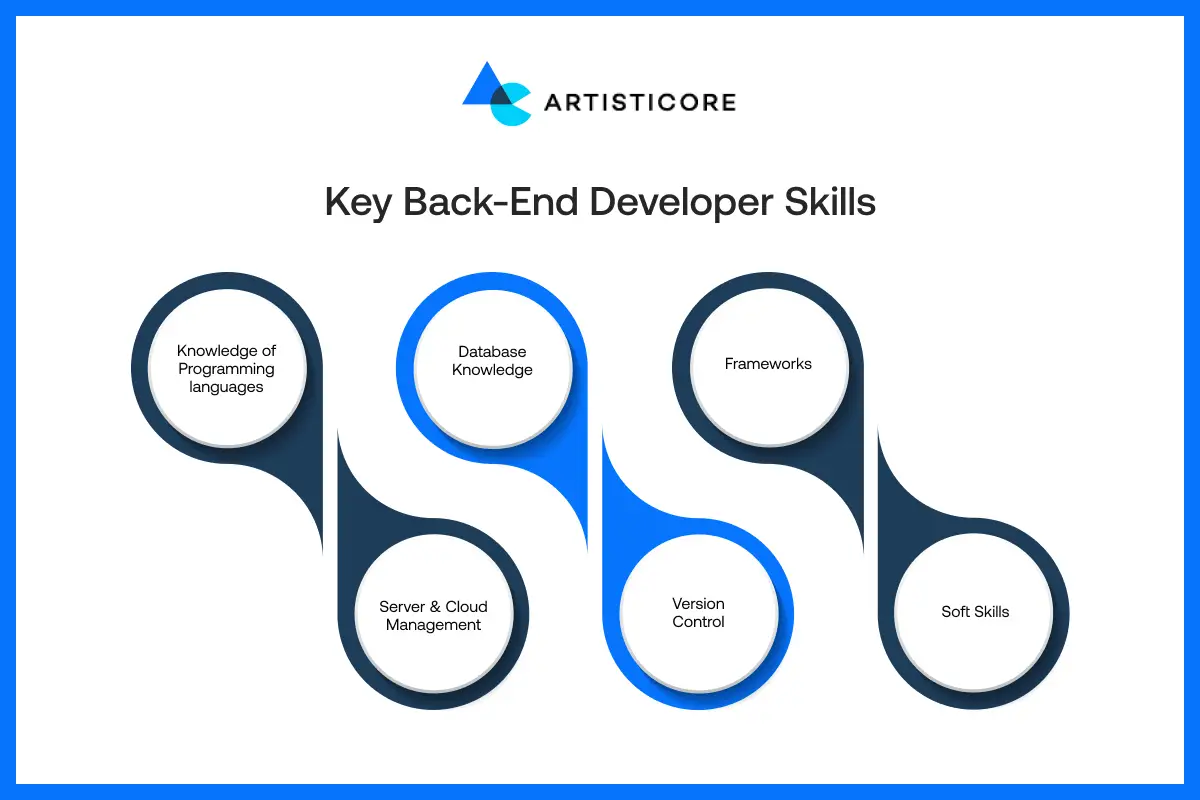
Then, what is a back end developer is ticking about? Consider them as the Swiss Army knife of the web world. They are the ones who work behind the curtain and play around with coding languages, database, and servers.
They are supposed to ensure that everything in a web site performs well, fast and safely. We will divide these skills in the most natural human way possible.
Programming Languages
There are number of back end programming languages that programmers use in general to do their work.
Python is a language that is among the most popular to choose since it is simple to learn and it is excellent in web and API applications, including Django or Flask.
Java is used in large scale enterprise systems, where tools like Spring do all the main work.
PHP is not new in the field and is used to run a massive part of the web. Mainly through frameworks such as Laravel.
Ruby with Ruby on Rails is reputed to have a rapid development and clean code.
Then there is Node.js, which enables programmers to run JavaScript on the server side. It ideal to everyone who would rather code the whole stack in the same language.
Database Knowledge
The back end would be the pantry in case the back end was a kitchen. Here you can maintain all the information of your app, including user profiles, orders, and notifications.
The back-end developers must understand how to store, organize and access this information without causing a slackdown.
SQL databases such as MySQL come in handy to manage and organize data. NoSQL databases such as MongoDB or Firebase are not rigid and are suited to applications where the data is unstructured, such as chat messages, updates feed, or real-time information.
Therefore, your SQL is ideal when there are user details or posts in beautiful rows and columns. However, when you are dealing with fast- moving messages or dynamic data, NoSQL comes in.
Frameworks
The shortcuts that all back-end developers enjoy are the frameworks. Frameworks are ready-to-use tools that hasten the process of creating all the features by themselves.
Python developers prefer Django or Flask, Java developers prefer Spring, PHP developers prefer Larval, Node.js developers prefer Express.js and Ruby fans prefer Ruby on Rails.
These applications save time and make the coding of the developers clean, structured and trustworthy.
Server & Cloud Management
After writing the code, it must reside somewhere, that is where servers and cloud platforms are in play.
Back-end developers must understand how to make their applications available, maintain them on-line, distribute traffic, and ensure they do not crash as soon as thousands of users appear.
It may be AWS, Azure, or Google Cloud, but cloud systems can assist them in controlling performance, security, and scaling as professionals.
Version Control
Anyone commits errors, yet there is a cheat code that developers can use to rectify them. Such tools as GitHub assist programmers in tracking changes, working with groups, and reversing the mistakes within seconds. It is the undo button of the whole project, it is literally, a career saver.
Soft Skills
Although the development of the back-end is very technical, soft skills are equally important.
Problem-solving is immense since bugs, errors, and performance problems constantly arise.
Teamwork is also critical, as back-end developers always collaborate with front-end developers, designers, product managers and even clients.
And of course, there has to be curiosity. Technology evolves rapidly, and the most effective developers are the ones that remain inquisitive and continue to learn.
And here is a fun fact to make things more real: Python is among the three most popular backend frameworks languages in the past five years. This alone proves that it is a great choice to start with.
Want to start your first backend project? Contact Artisticore to create a basic Python-based and a SQL database login system.
Backend Technologies and Tools
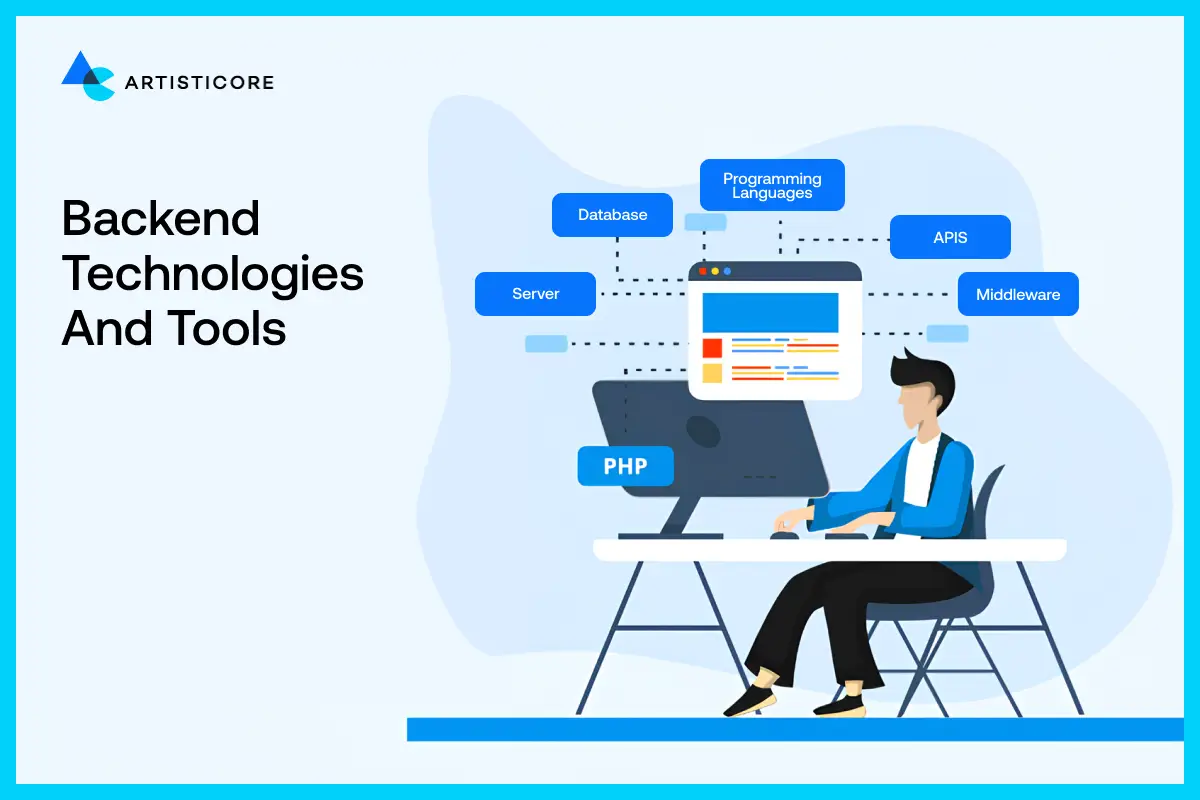
After understanding the basics of what is back end development, let us dig into tools and technologies. These tools are used by backend developers to ensure the process of backend development is quicker and free from errors.
1. IDEs
It is your coding workstation, giving you everything under a single roof. IDEs give you everything under a single roof. VS code is a lightweight and flexible program that offers number of extensions. Along with this are IntelliJ IDEA which is perfect for Java developers. PyCharm is another IDE program which works well for Python projects,
2. Database Tools
Without the appropriate tools, databases may be disheartening. MySQL Workbench allows viewing, querying, and maintaining SQL databases. pgAdmin is a tool necessary to PostgreSQL users. These tools assist you to look at your data and maintain it.
3. API Testing Tools
The front end is linked with the back end via APIs. Their testing ensures that connections are good. Postman also allows you to send requests and check replies. Test APIs and swagger documents. These links help your application to talk in perfect harmony.
4. Deployment Platforms and Servers
Once you are done with the coding, then you must make your app available on-line. Cloud computing providers such as AWS, Azure, and Google cloud systems deal with hosting, scaling and uptime. Then there are Docker and Kubernetes that help package your app so that your app to run everywhere without a glitch.
Mini Example of Back End Services: How It All Comes Together
Imagine building a blog app. You would be writing Python in VS code, testing APIs using Postman, maintaining the database in MySQL workbench, and deploying it on AWS. And the, you have your app live all over the internet.
Want to practice like a pro? Install a mini project using Python, a database, and Postman.
Career Path and Growth Opportunity
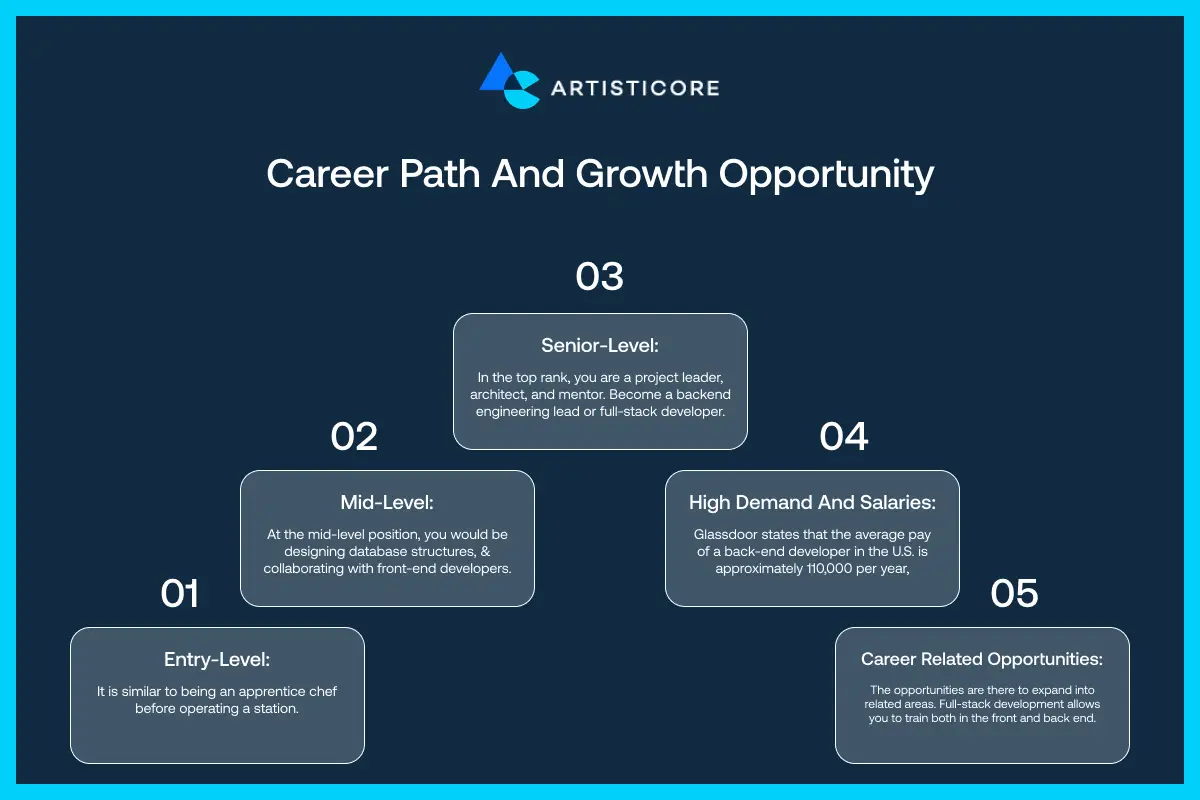
Entry-Level
You may have asked yourself whether you can become a back-end developer, the answer is yes. Small projects that entry level developers work on include creating APIs, simple databases, or server requests. It is similar to being an apprentice chef before operating a station.
Mid-Level
As you gain more experience, there would be also the mid-level positions where you would be designing database structures, enhancing performance, adding security, and collaborating with front-end developers. You are not just following recipes but you begin to make solutions.
Senior-Level
In the top rank, you are a project leader, architect, and mentor. Become a backend engineering lead, cloud architect or full-stack developer, both with front-end and back-end skills, is also possible.
High Demand and Salaries
Another piece of information that is quite interesting is that Glassdoor states that the average pay of a back-end developer in the U.S. is approximately 110,000 per year, with senior positions possible to earn up to 150,000 or higher. Demand is increasing because firms require more complex web apps.
Career Advancement and Related Career Opportunities
The opportunities are there to expand into related areas. Full-stack development allows you to train in front and back end. Devops and cloud engineering are concerned with deployment, server management and scaling. Back-end development provides access to numerous tech jobs involving highly transferable and demand skills.
How to Learn Back-End Development: Step-by-step Guide
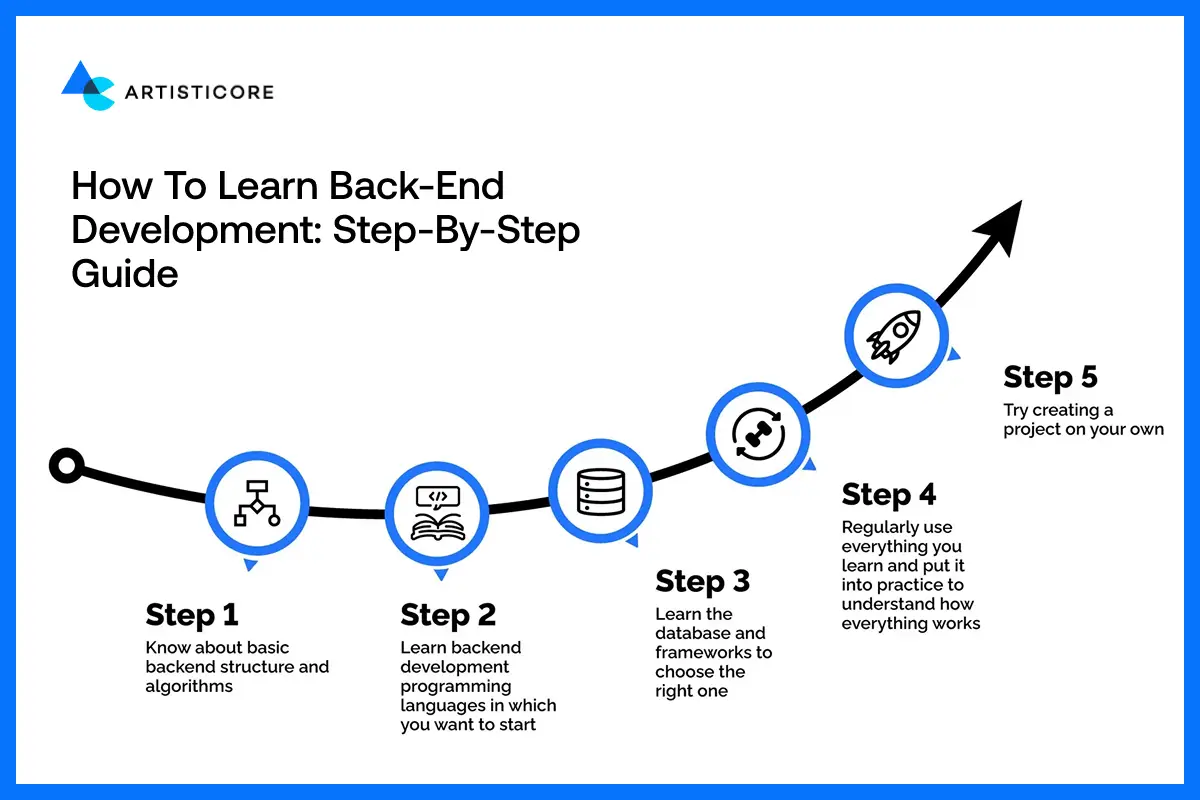
Back-end development may seem like reading a giant cookbook in a language one does not understand, which is fine. You need not know it all at the same time. One small step at a time is the best and practice will make perfection.
Start with the Basics
The first thing to do is to select a programming language. Python is simple to learn and is popular with back-end applications. It possesses such tools as Django and Flask which assist one to build fast. Java suits big business applications. Node.js can be used to write the server in JavaScript.
Learn Database Management
Next learn about databases. Begin with SQL to understand how data is organized. Then give a go to NoSQL databases like MongoDB that allow you to store data in a more accommodating manner. Making a short project such as an inventory list or a basic blog database will be very informative.
Build Small, Real Projects
The most important is to gain practical experience. Begin with small projects like:
- A to-do list application that stores tasks in a database.
- Checking user login system.
- A basic blog that allows you to post, edit and delete articles.
Projects allow you to identify how everything attributes to each other, server side, database and the front end.
Practice Working with APIs
APIs bridges the gap between the users and the server. Create a basic REST API and check it using such tools as Postman. This demonstrates software communication amongst themselves.
Discover Deployment and Hosting
Once your application is running on your personal computer, you need to install it to the internet on such services as AWS, Azure, or Google Cloud. Even a simple online application will make you more confident and demonstrate the way real apps work.
Learn with Developers and Communities
By joining these groups and understanding the work of communities, you will learn better. They help you better understand the best practices necessary to achieve better outcomes. By joining such groups, you get constructive feedbacks how other (big names) work.
Fun Tip
Some excellent developers started out with simple, and sometimes entertaining, projects, such as a list of recipes or a movie tracker. It is not about being good, but doing it regularly.
Typical Back End Development Problems and How to Address Them?
Back-end development is thrilling, yet, just like the busy kitchen during a dinner shift, it presents its problems that are capable of challenging your talent, speed and problem-solving.
Protect and Secure Data
The security of user data is of top priority. Security can be compromised, and hackers will creep in like pests. To ensure information security, developers rely on the security rules, encryption and checks on logins.
It is important for you to hash your passwords and keep your connections safe using SSL certifications.
Check Server Performance
When a server is not ready, a sudden increase to 10,000 users will crash the server. When you index your database, you basically balance your website load, hence, allowing your apps and websites to load fast.
According to the stats stated in Wiro Agency, even a 1 second delay can decrease the sales by 7 percent.
Front End Use
Back-end and front-end should be in harmony, just as chefs and waiters. Good documentation, clear APIs, and frequent testing prevent the issues with communication.
Staying in the Fast-paced Technology
New tools and structures are emerging on a regular basis. As a back end developer, when you keep on experimenting, reading, doing courses and learn new tools, you get deeper understanding of your work as a developer.
Problem-Solving and Debugging
Servers do not necessarily act as required. Fixing and debugging bugs are habits that make you become more logical and patient.
After going through each challenge successfully, you come out more confident with more refined skills in your pocket as a developer.
Conclusion
What is back end development? The blog revolves around this one question and to answer it in a layman words, we can say that it is the backstage staff of your favorite show.
It operates silently and invisibly, but it is absolutely necessary. It includes code writing, data administration, server administration, and application security and performance.
Your favorite websites, applications or online tools would be impossible to use without it.
Backend development is vibrant, required and has plenty of growth opportunities. If you want to study what is back end development or want to become a talented back end developer, hold power on tools like Python, and test APIs. And yes, do arrange your first back end development project on AWS.
Experiment with tiny undertakings, study new structures, and continue coding. The web requires more developers with an understanding of what goes on behind the scenes.
Start Your Back-end Project Today!
It is high time you begin to build your own app and take your business to another level. Contact Artisticore to get a free consultation and decide yourself.
FAQs
The most popular back-end languages are Python, Java, PHP, Ruby, Node.js and Go. Python is simple to begin with and can be used in all types of projects. Java is suitable to big business applications.
You do not need a college education. A large number of developers receive training in boot camps, online, and real-world projects. A degree is an advantage, but experience is as well valued.
If you really want to know what is back end development, first of all, do not set a time. It varies from one individual to another. I may take a year and you can learn in 6 months so it completely varies. However, to get a hold on all the backend development services, as a beginner it may take you 6 months. However, two years may not be sufficient to master advanced topics.
To simply understand the difference between both, think of it as a book. The cover you look at before buying is front end but if you are reader, you would also look into it, and feel the pages. Back end development is the story that makes you read the whole book, it is the scene behind the website. There is also full stack development which deals with both the front end, the part that is visible to the users and the back end, which works in the background.
They take care of servers, databases, APIs, security and optimization of performance. Basically, they ensure smooth, safe and efficient operations of websites and applications behind the scenes.

Hafsa Hanif is a talented content writer at WebnHubs, specializing in topics such as graphic design, web design and development, logo design, and animation. With her deep understanding of design principles and creative processes, Hafsa crafts engaging, informative, and SEO-optimized content that resonates with readers. Her expertise in SEO ensures that her articles not only captivate audiences but also rank well on search engines, helping businesses boost their online presence through compelling design-focused narratives.
